

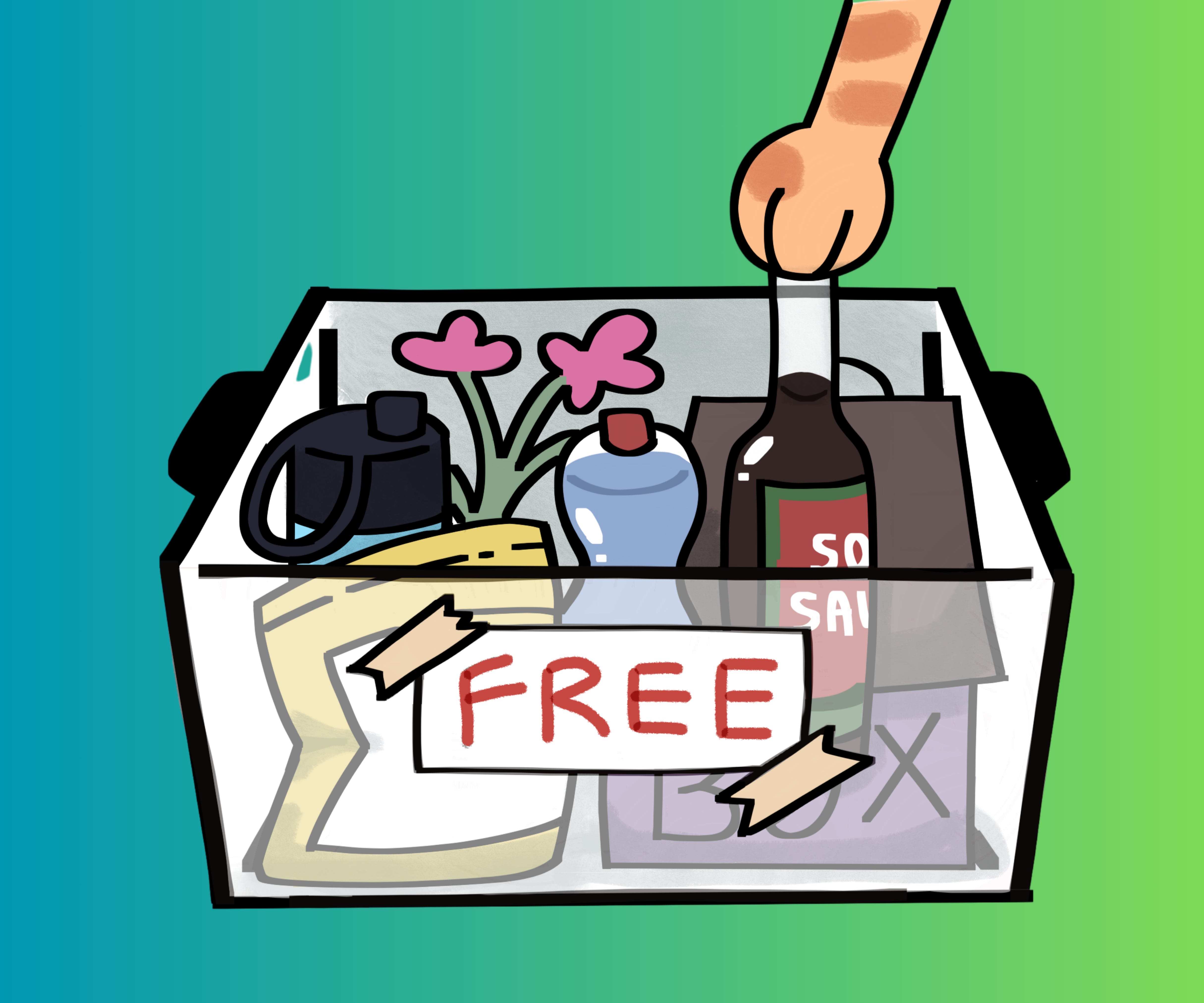
Every few days, I leave something on my front porch in my designated Buy Nothing box. An extra water bottle I got at a conference. A skirt that didn’t quite work for me. Some snacks my kids thought they liked at the store, but changed their minds about. I have given away over a thousand items, from an extra gallon of milk before heading out on vacation to a spare TV we didn’t want to take with us on the move. Within a day or two, the item is off to a new home somewhere in my neighborhood.
I have been part of this local group for years. The requirements to join are strict, and the admins enforce the rules fairly. Our community is small, and it is built around a shared zip code. But we share a sense of being in the same neighborhood and trust. The group has at least a dozen things listed every day, including furniture, electronics, and clothes our kids outgrew overnight. My husband thinks the food is the funniest part. But half-finished bags of food, or even leftovers, are popular. Taking food from strangers is the kind of thing that seems odd, but in a high-trust community, it has never once been a problem.
Compare that to our larger regional Buy Nothing groups, which cover more zip codes and more people. They technically work the same way, but they feel different: more distant and less intimate. And then there’s Facebook Marketplace, which I worked on, where you’re transacting with true strangers, and trust has to be built transaction by transaction.
The difference between these three circles isn’t the platform, which remains the Facebook app. Rather, it is trust.
The Trust Problem Is Bigger Than It Looks
I wrote last week about Ten Charts I Can’t Stop Thinking About. One of them was about how low-trust America has become. Roughly half of Americans believe their fellow citizens are morally bad. This is alarming. We think our fellow Americans are bad people, much more so than in any other country.
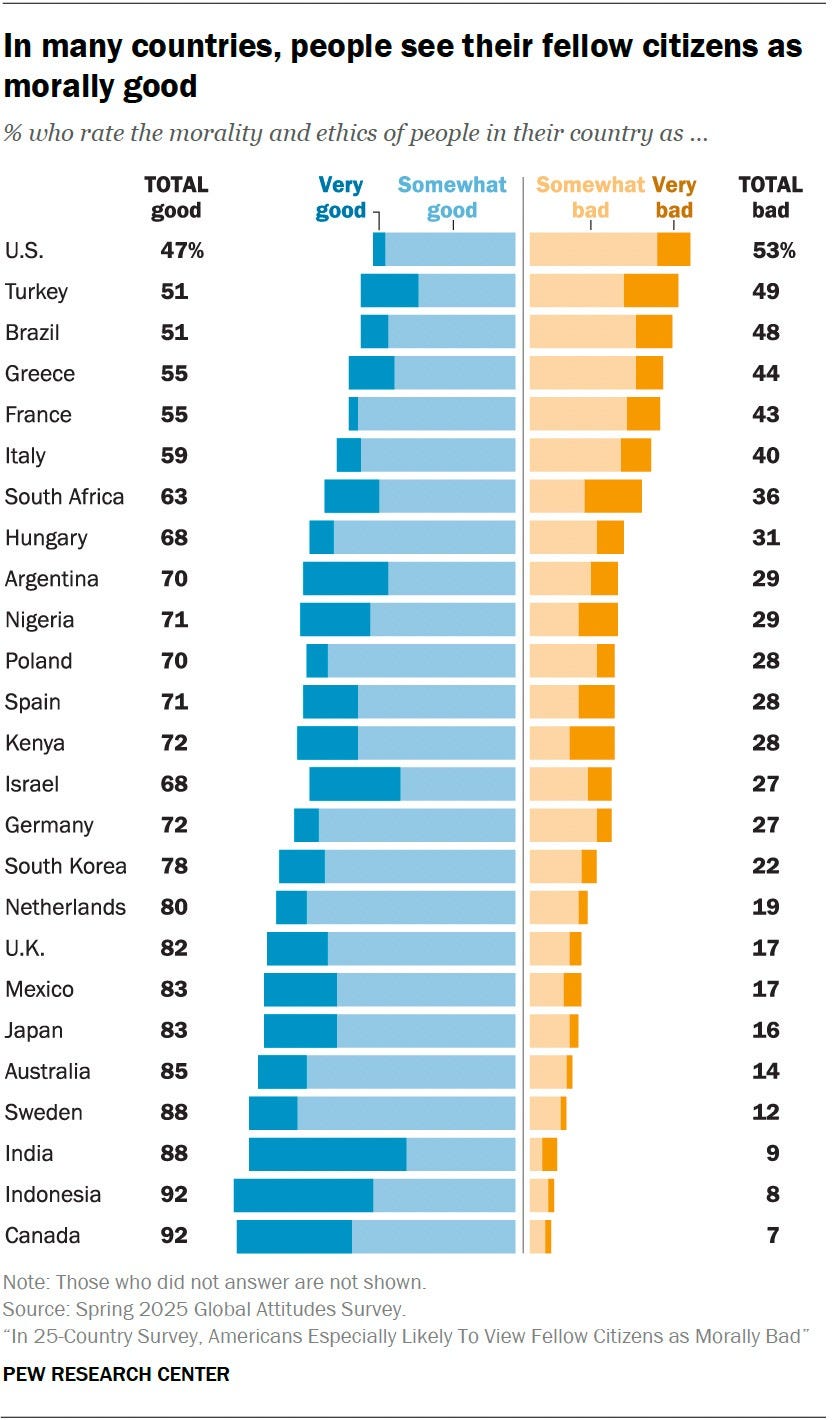
That statistic has consequences far beyond politics. Low-trust societies spend more on security, legal costs, and verification. They also advocate for more policing and harsher penalties for offenses. Low-trust societies have lower organ and blood donations.
Low trust makes everything slower and more expensive, because you have to build in protection against the worst case instead of assuming the best one. A high-trust society often supports social programs because the money is going to your neighbors, but if you think half of them are bad people, you are less likely to support free school lunch, food stamps, or Medicaid, because you assume people may take advantage of the system.
I felt this most viscerally on a work trip to Utah. A group of us from the Bay Area got out of the car, and as we do in SF, we took our bookbags out of the car. We even debated pulling out our suitcases. One of our Utah colleagues watched us do this and looked genuinely confused. “You can leave that. No one is going to steal it,” he said. “We don’t even need to lock the doors.”
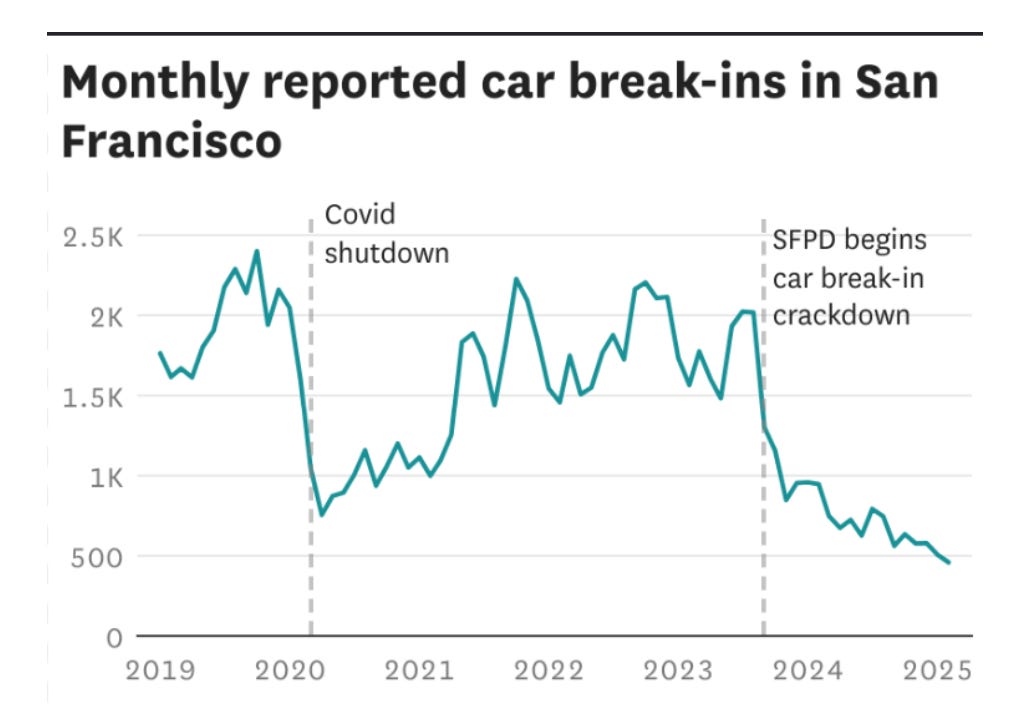
I was shocked. In California, leaving a visible bag in your car is practically an invitation to a break-in. I have had friends lose laptops and luggage this way. While it has gotten meaningfully better in San Francisco since Daniel Lurie became mayor, I still would never leave anything of value in my car. That instinct to take your things doesn’t go away because the statistics improve. Once you’ve been burned, you carry that caution with you.
That’s what low trust does. It doesn’t just cost you when something actually gets stolen. It costs you cognitive friction every day in the form of vigilance.
Organizations Have the Same Problem, at a Smaller Scale
I have seen this exact dynamic play out inside companies. Some teams operate like my local Buy Nothing group. Team members give each other the benefit of the doubt. They share credit freely and openly. They give honest feedback, and there’s an ease to their conversations. Mistakes are treated as information, not ammunition to be used down the line.
Other teams operate like the larger groups, or even Facebook Marketplace. Every interaction is a transaction. People protect their scope, hedge their commitments, and secretly negotiate with other teams. I have watched teams like this develop what researchers call “in-group trust”: a tight, defensive circle where you trust the few people in your immediate pod and no one else. It works well until it doesn’t. It is protective, but also poisonous. The circle-the-wagons mentality helps drive a local maximum, but risks everything outside that circle. People stop collaborating across teams because it feels risky to depend on someone who isn’t part of the group.
The irony is that in-group trust often masquerades as a strength. Team loyalty looks like a good thing from the inside. But if that loyalty is built by defining an “us” against a “them,” you haven’t built trust. You’ve just moved the low-trust problem down a level, from the company to the department, from the department to the XFN or pod.
How High Trust Actually Gets Built
None of the high-trust systems I have described (my neighborhood, that Utah trip, the best teams I’ve been part of) got that way by accident. A few things they had in common:
Repeated small interactions, not big declarations. Nobody in my Buy Nothing group signed a pledge to trust their neighbors. Trust accumulated one bag of spare clementines at a time. In organizations, it’s the same. Trust is built through the small, unglamorous moments where you did what you said you’d do, not through a mission statement about collaboration or teamwork.
Proximity that makes people specific instead of abstract. My tight local group works because I actually know these people, even if only a little. The regional group feels distant because the people in it stay abstract. On teams, this means trust breaks down the moment people become job titles or Slack handles instead of humans you’ve had real conversations and been through trials with.
Transparency as the default, not the exception. On one team I led, we had a rule: say the thing, in the room, out loud. No side conversations, no quiet lobbying after the meeting, no regrets about what you didn’t say. We built that rule because trust can easily erode to the point where everyone suspects a hidden agenda. Saying the thing ensured transparency and trust.
Leaders who go first. Trust rarely spreads because someone announced it should. It spreads because someone with more power or tenure took the first risk, extended the first benefit of the doubt, and admitted the first mistake. Once people see that the risk of trusting doesn’t get punished, they take it themselves.
The Real Question
The real question isn’t whether your team or your neighborhood has high trust or low trust today. It’s whether the circle of trust is expanding or contracting day by day. Tribal trust that never grows past a small, defensive “us” is just a more comfortable version of low trust. Real high-trust cultures keep widening the circle with each small, repeated act. You don’t even see the threshold crossed until one day you leave your bookbag with a laptop in it in your car.
Where is the edge of your circle of trust right now? And what would it take to move it out one ring further?
Wow, that Buy Nothing group is neat! I haven't heard of that - what a great concept. Thanks for sharing as always a thoughtful analysis of a universally important topic.
I see this exact dynamic with clients and financial advisors. Trust isn't built by a one-time comprehensive plan—it's built through quarterly reviews and transparent fee discussions.
Indian clients are skeptical of advisors because they've been burned by commission-driven products. When I openly show my fee structure and admit when a product isn't right for them, the circle of trust expands.
It's the small, consistent actions that make clients leave their financial 'bookbags' with me.